If you handed me a brand-new domain and told me to build a local SEO site that compounds for the next five years, this is exactly the architecture I’d build.
Most local service businesses think about their website as a brochure: home, about, services, contact. That structure was fine in 2014. In 2026 it leaves 80% of the addressable local search traffic on the table. The sites that compound year-over-year — the ones that quietly take over a market’s Map Pack and stay there — are built on a deliberate architecture that treats every service × every city as its own SEO surface.
Here is exactly how I’d structure a local SEO site in 2026, assuming a brand-new domain and a service business operating across a defined geographic region. The framework applies whether you’re a plumber in the Inland Empire, a dentist in Phoenix, or a CPA in Tampa.
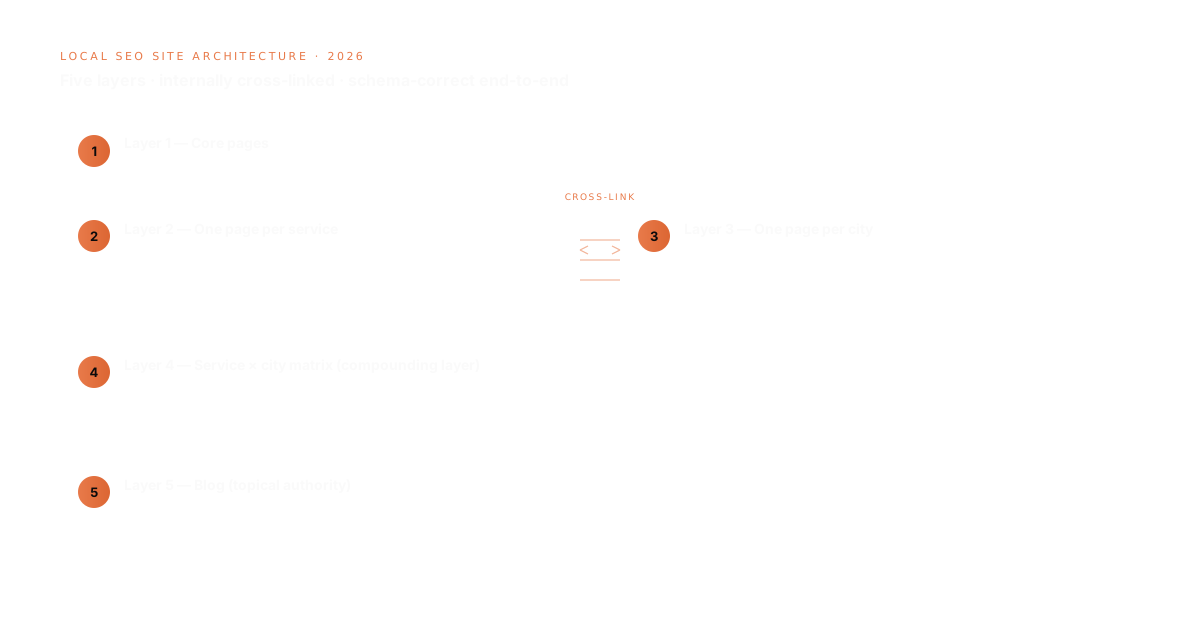
Layer 1: The core pages (the ones every site has)
- / — Homepage. One H1 with primary keyword + city. LocalBusiness schema. Internal links into Layer 2 and Layer 3.
- /about — Founder story, license/credentials, trust signals. Person schema linked to Organization schema.
- /services — Services hub page. Lists every service line, each linking to its own /services/[slug] page.
- /pricing — Plans or price ranges. Service schema with offers where appropriate.
- /contact — Contact info, form, NAP block. ContactPage schema.
- /blog — Insights hub. Each post is its own URL with BlogPosting schema.
Layer 2: One page per service (the service silo)
/services/[service-slug] — one page per discrete service you offer. For a plumber that means /services/drain-cleaning, /services/water-heater-installation, /services/slab-leak-detection, /services/sewer-line-repair, /services/emergency-plumbing. Each page targets one primary service-intent keyword and 2–4 semantic variants.
Each Layer 2 page contains: a 100–150 word lead, an explanation of what the service involves, typical symptoms or use cases, what the process looks like, typical pricing or price ranges, an FAQ section (3–5 questions), a section called ‘Service Areas’ that links to every relevant Layer 3 page, and a CTA. Word count: 1,000–1,500. Schema: Service + FAQPage + BreadcrumbList.
Layer 3: One page per city (the location silo)
/locations/[city-slug] — one page per city you serve. For an IE service business: /locations/riverside, /locations/corona, /locations/moreno-valley, /locations/eastvale, /locations/norco, /locations/jurupa-valley, etc.
Each Layer 3 page contains: a lead that names the city, neighborhoods, and any locally-relevant context (e.g., ‘Eastvale’s newer slab construction means slab leak detection is the #1 service we run in this ZIP’), a list of services offered in that city (each linking back to Layer 2), real local references — landmarks, school districts, nearby cross-streets, anything that confirms the page wasn’t written by someone who’s never been there, a city-specific FAQ, and a CTA. Word count: 800–1,200. Schema: LocalBusiness + Service + BreadcrumbList.
Why city pages matter so much: ‘plumber Riverside’ and ‘plumber Corona’ are different search queries with different competitive sets. A single ‘Service Areas’ page can’t rank for both. The site with discrete pages per city captures both queries; the site with one combined page captures neither.
Layer 4: The service × city matrix (the compounding layer)
Optional but powerful for mature sites: /services/[service]/[city] pages that combine a specific service with a specific city. ‘Slab leak detection in Eastvale.’ ‘Water heater installation in Corona.’ ‘Emergency plumber in Moreno Valley.’ This layer captures the long-tail commercial queries that have low absolute search volume but extremely high conversion intent.
Two caveats. First: don’t build these as thin doorway pages. Each one needs genuine, specific content that earns its existence — otherwise Google will hit you with Helpful Content Update suppression. Second: build out Layer 2 and Layer 3 fully before adding Layer 4. The matrix is leverage on top of an existing foundation, not a replacement for it.
Layer 5: The blog (the topical authority layer)
/blog/[post-slug] — substantive (1,500+ word) cornerstone posts plus tactical (800+ word) supporting posts. Each post: BlogPosting schema, Author schema linked to a Person on /about, FAQ schema where applicable, internal links into Layer 2 and Layer 3, external links to authoritative sources.
The blog’s job is twofold. It captures informational-intent queries that pre-stage commercial-intent decisions (‘how long does a water heater last,’ ‘what is a slab leak,’ ‘when should I replace my furnace’). And it builds topical authority that lifts the entire Layer 2 and Layer 3 set — Google increasingly evaluates whether the publisher of a service page actually knows the domain.
Internal linking — the silo with cross-stitching
Pure silo architecture (services-only-link-to-services, locations-only-link-to-locations) is outdated and gives up too much equity. The modern approach is silo with deliberate cross-links:
- Every Layer 2 service page links to every Layer 3 city page (in a ‘Service Areas’ section).
- Every Layer 3 city page links to every Layer 2 service page (in a ‘Services Offered in [City]’ section).
- Every blog post links to at least 2 Layer 2 service pages and 1 Layer 3 city page where contextually relevant.
- Homepage links to all Layer 2 pages and the top-tier Layer 3 pages.
- Layer 4 (service × city) pages link up to their parent service and parent city pages.
Schema strategy — what goes where
- Root layout: LocalBusiness JSON-LD (with sameAs links to GBP, Facebook, LinkedIn, etc.). Applied to every page.
- Every non-home page: BreadcrumbList JSON-LD reflecting the page’s position in the hierarchy.
- Homepage, Services, and high-traffic pages: FAQPage JSON-LD.
- Service pages: Service JSON-LD with areaServed listing every city in Layer 3.
- Location pages: LocalBusiness JSON-LD with the city-specific address or service area, plus Service entries.
- Blog posts: BlogPosting with Author Person schema linked to Organization.
Technical floor — non-negotiables
- Mobile LCP under 2.5s, INP under 200ms, CLS under 0.05.
- HTTPS with HSTS preload header.
- Sitemap.xml dynamically generated, includes every URL, submitted to GSC.
- Robots.txt references sitemap, allows everything that should be crawled.
- 404 returns 404 status. Error states caught and logged.
- OpenGraph and Twitter card metadata on every page.
- Phone tappability site-wide via sticky header.
Build order — what to ship first
If I were launching this site tomorrow with a single founder’s bandwidth, I’d ship in this order:
- Weeks 1–2: Layer 1 + Layer 2 (homepage + about + contact + every service page). This is the minimum viable site.
- Weeks 3–4: Layer 3 — every city page. This is the single highest-leverage SEO move after Layer 2.
- Weeks 5–8: Blog — three cornerstone posts targeting the highest-value informational-intent queries.
- Weeks 9–12: Schema cleanup, technical audit, Core Web Vitals tuning, GBP completion, citation buildout.
- Month 4+: Layer 4 (service × city) pages, one new blog post per week, ongoing CRO.
This is the architecture I’d use for any local service business in 2026. It’s the same skeleton this site is built on — services, locations, industries, blog, all layered, all schema-correct, all internally linked. If you want help building this for your business or auditing your existing site against the framework, the contact form gets a personal reply within one business day.